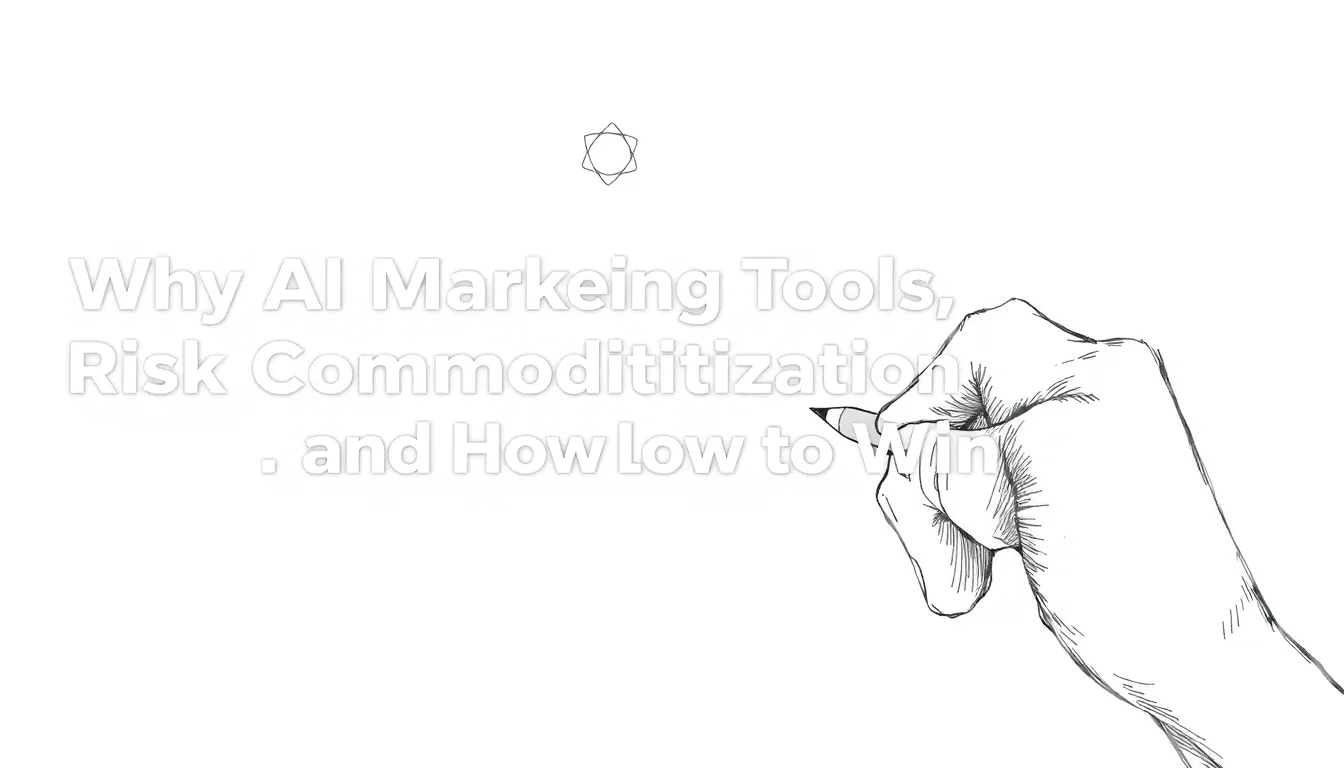
Why AI Marketing Tools Risk Commoditization and How to Win
The Efficiency Trap: When Everyone Moves at the Same Speed
Artificial intelligence has transformed the pace of modern marketing, allowing teams to produce content, analyze data, and execute campaigns faster than ever before. Platforms leveraging AI Tools Integration promise unprecedented productivity gains, and many businesses are racing to adopt them. However, there is a fundamental flaw in treating speed as a competitive advantage. When every organization gains access to the same AI-powered workflows, the playing field does not tilt in anyone’s favor — it simply resets at a higher tempo. This phenomenon mirrors what evolutionary biologists call the Red Queen hypothesis, borrowed from Lewis Carroll’s fiction: you must keep running just to stay in place. If your entire growth strategy depends on being faster with ChatGPT, Gemini, or Claude, consider this — your closest competitor has the exact same subscription. Efficiency, by its very nature, is a symmetric benefit. Everyone can purchase it, implement it, and scale it at roughly the same cost and timeline. The true danger is not falling behind technologically; it is winning the efficiency race only to discover that margins have collapsed and customers can no longer tell one brand from another. Speed without direction is simply organized commoditization.
Asymmetric Impact: Standing Out in an AI-Saturated Market
The antidote to commoditization is not abandoning AI — it is using it in ways your competitors have not yet imagined. An AI Content Aggregator, for example, can do far more than recycle trending topics. When paired with proprietary data, unique audience insights, or unconventional distribution strategies, it becomes a tool for genuine differentiation. The key lies in pursuing asymmetric impact: advantages that are difficult to replicate because they stem from knowledge, relationships, or creative positioning that others simply do not possess. Think less about optimizing existing processes and more about reimagining what your business could look like if you were building it from the ground up today. What problems would you solve differently? What customer frustrations have gone unaddressed because legacy systems made solutions impractical? These are the questions that separate market leaders from market followers. Disruption does not always mean launching an entirely new product. Sometimes it means reframing the value you already deliver through an entirely new lens. Businesses that survive the current AI wave will be those that use these tools to unlock possibilities previously out of reach, rather than merely accelerating what they were already doing.
Rethinking Growth: From Automation to Strategic Evolution
Sustainable marketing growth in the age of AI requires a fundamental mindset shift. Tools like Auto Backlinks Builder and advanced AI Tools Integration offer real tactical advantages, but only when deployed within a broader strategic framework designed around uniqueness rather than uniformity. A useful exercise is to ask yourself honestly: if you were launching this business today with all available technologies at your disposal, would you build it the same way? If the answer is no, that gap between your current operation and your ideal startup represents untapped opportunity. Loss aversion often keeps organizations clinging to familiar methods, even when better paths are visible. Flipping that psychological tendency around — asking not what you would lose by changing, but whether you would consciously choose your current approach if starting fresh — can unlock remarkably clear strategic thinking. Companies that treat AI as a catalyst for reinvention rather than a cost-cutting mechanism will be positioned to lead their categories. The businesses that simply automate their existing workflows will find themselves in a relentless price war with competitors doing exactly the same thing. Ultimately, the goal is not to run faster than the Red Queen demands, but to change the game entirely and compete on entirely different terms.
Source: The real risk of AI is marketing commoditization | MarTech